SBR — Sequencing Batch Reactor
A fill-and-draw activated sludge system for large flows
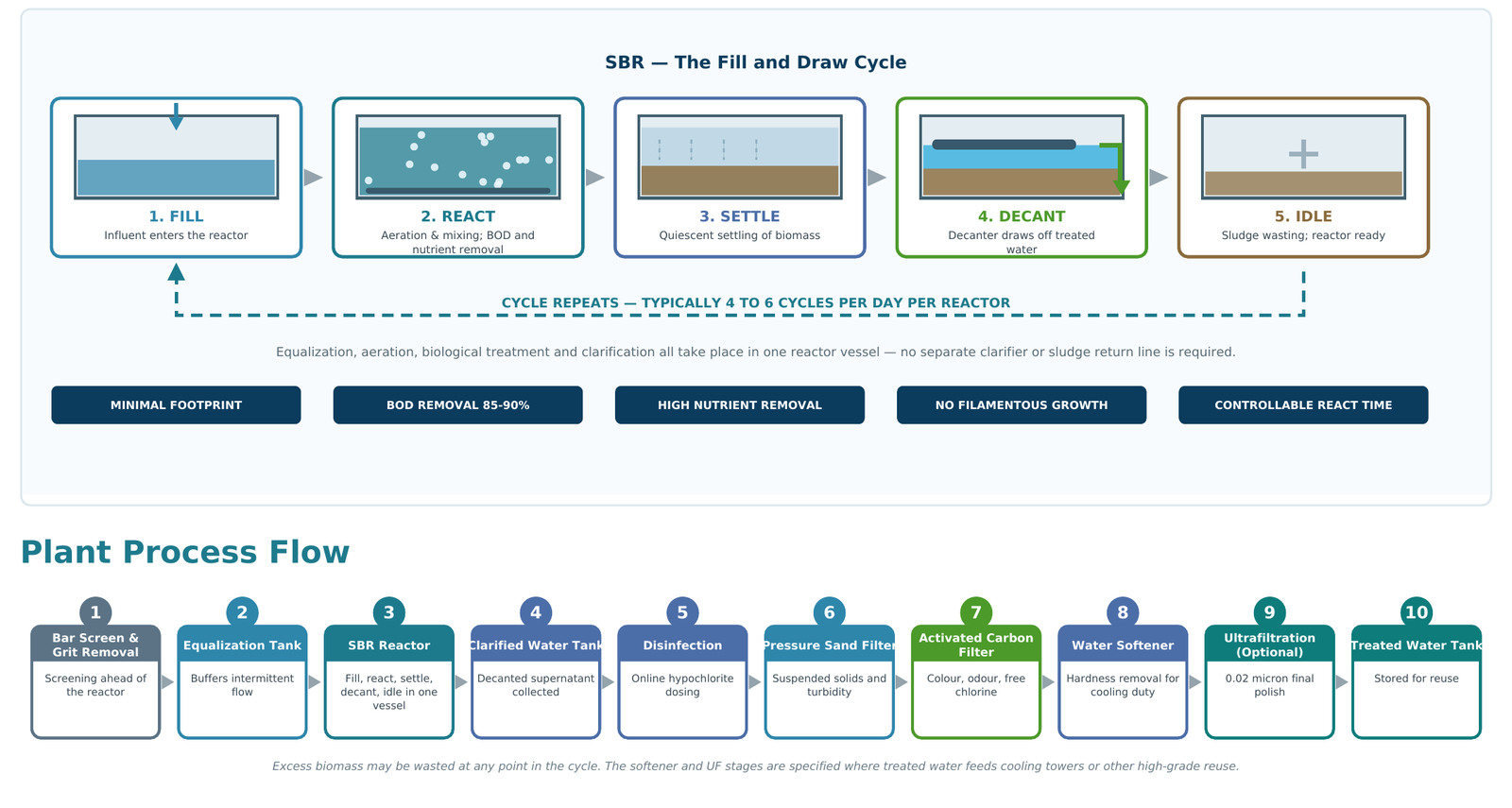
The SBR is a fill-and-draw activated sludge system. Wastewater is added to a single batch reactor, treated to remove undesirable components, and then discharged. Equalization, aeration and clarification are all achieved in one reactor. Two or more reactors are operated in a predetermined sequence to optimise performance.
Supplied from 50 KLD to 2 MLD and above.
Cycle
The Fill and Draw Cycle
Cycle repeats — typically 4 to 6 cycles per day per reactor
1. Fill
Influent enters the reactor
2. React
Aeration & mixing; BOD and nutrient removal
3. Settle
Quiescent settling of biomass
4. Decant
Decanter draws off treated water
5. Idle
Sludge waiting; reactor ready
Process
Plant Process Flow
Specification
Fill Strategies
| Option | Strategy | Notes |
|---|---|---|
| A — Static Fill | Influent added with no mixing or aeration. | High food-to-microorganism ratio; favours floc-forming organisms, good settling sludge, supports biological phosphorus removal. |
| B — Mixed Fill | Influent organics mixed with biomass, initiating biological reactions. | Bacteria use residual oxygen then nitrate nitrogen as electron acceptor — denitrification occurs under these anoxic conditions. |
| C — Aerated Fill | Aeration begins during filling. | Shortens the react step; used where cycle time is the binding constraint and nutrient removal is not the governing design criterion. |
Advantages
Advantages of SBR
- Equalization, primary clarification, biological treatment and secondary clarification in a single reactor vessel.
- Requires small space — minimal footprint.
- Controllable react time and quiescent settling.
- High nutrient removal capability, including biological nitrogen and phosphorus removal.
- BOD removal efficiency generally 85 to 90%.
- Filamentous growth elimination through controlled fill strategy.
Planning a large township or municipal plant?
SBR is our recommended process for large flows with high nutrient removal requirements.
Contact Us